Design-build is a project delivery method where a single entity handles both the design and construction of a project under one contract with the owner. This unified structure eliminates the traditional gap between architect and contractor, which is where most project delays and budget overruns originate. The result is faster timelines, clearer accountability, and tighter cost control from day one.
Most construction projects fail not because of bad materials or unskilled workers. They fail because the architect and contractor are working from two different agendas. Design-build closes that gap by fusing both roles under a single contract. If you’ve ever watched a project spiral into delays and finger-pointing, this model exists specifically to prevent that.
Key Takeaways
- Design-build means one contract, one team, and one point of accountability for both design and construction.
- It’s commonly called “integrated project delivery” or simply “DB” in the industry.
- Design-build typically delivers projects 33% faster than the traditional design-bid-build approach.
- The main disadvantage is reduced owner control over the design phase, since decisions move quickly.
- Progressive design-build adds a phased collaborative step before the full contract is locked in, giving owners more flexibility early on.
- You can usually tell a project is design-build if a single firm is responsible for both the drawings and the build budget from the start.
What Is the Design-Build Approach, Really?
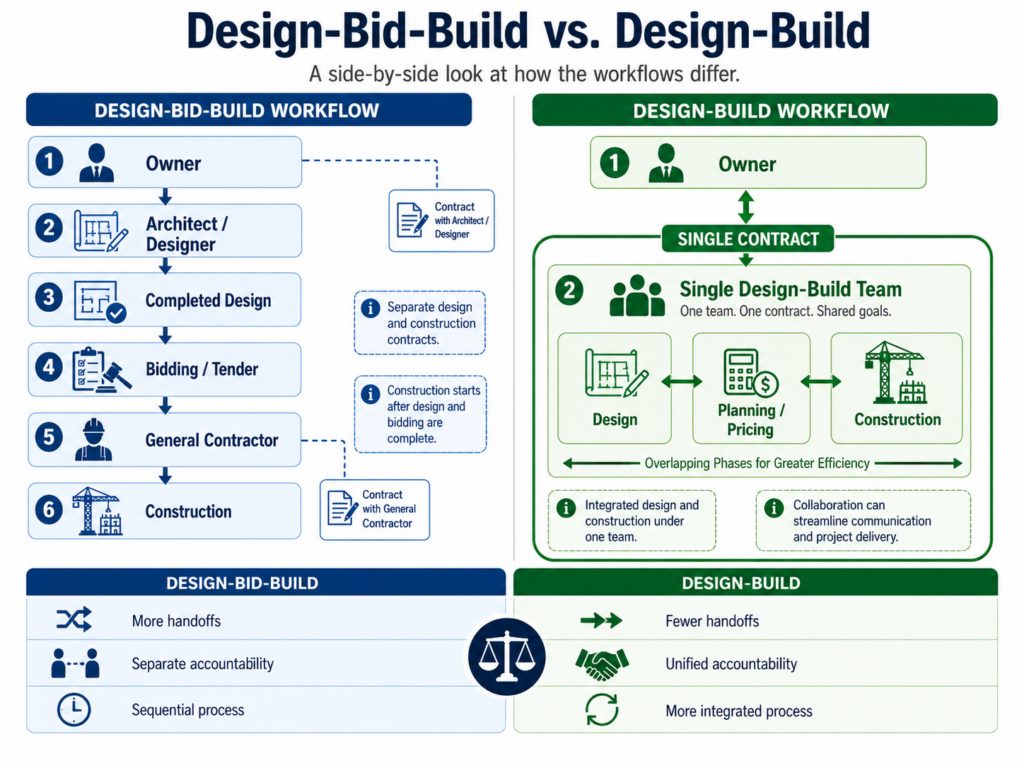
The design-build approach bundles architectural design and physical construction into a single contractual relationship. The owner signs one agreement with one entity, often called the design-builder, who then manages all subcontractors, engineers, and architects internally or through a pre-coordinated team.
In traditional project delivery, the owner hires an architect, waits for completed drawings, then sends those drawings out to contractors for competitive bids. That handoff creates conflict by design. The architect has no financial stake in how buildable or affordable the design is. The contractor has no input into decisions that directly affect their costs. Design-build eliminates that adversarial structure entirely.
Studies from the Design-Build Institute of America consistently show that design-build projects are delivered 33% faster and with 6% lower cost growth compared to the design-bid-build method. These aren’t marginal improvements. On a $10 million project, that cost differential alone can fund significant scope additions or simply stay in the owner’s pocket.
What Is Another Name for Design and Build?
The method goes by several names depending on the sector and region. In the engineering and infrastructure world, you’ll often hear it called EPC, which stands for Engineering, Procurement, and Construction. In public works, it’s sometimes labeled as “turnkey delivery.” In the UK and parts of Europe, “design and build contract” is the formal term. Some firms, including Buildform, simply refer to it as integrated delivery.
Regardless of the label, the core principle is identical: one entity holds responsibility for both the design documentation and the physical construction outcome.
| Term | Common Context | Key Distinction |
| Design-Build (DB) | Commercial, residential, public projects | Single contract for design + construction |
| EPC | Oil, gas, infrastructure, industrial | Includes procurement of all materials |
| Turnkey Delivery | Government, large-scale civil works | Owner receives a fully finished asset |
| Integrated Project Delivery (IPD) | Complex institutional builds | Shared risk/reward across all parties |
| Design and Build Contract | UK and European markets | Formal legal term for the same DB structure |
Why Is Design-Build Better Than Traditional Methods?
The honest answer is: it’s not automatically better for every project. But for most commercial builds, renovations with tight timelines, and projects where budget certainty matters most, it consistently outperforms the alternatives. Here’s why.
When the designer and builder are the same team, value engineering happens in real time. Instead of an architect drawing a $2 million facade and then watching the contractor price it at $3.1 million, the design-build team has that conversation during design. The solution gets built into the drawing, not discovered after the bid.
Owner satisfaction rates in design-build projects tend to run significantly higher than in design-bid-build projects. Research from the Construction Industry Institute has found that DB projects experience fewer disputes, fewer change orders, and lower unit costs when measured against comparable scope delivered through traditional methods.
- Single point of contact: Owners don’t mediate between a frustrated architect and a defensive contractor. One call handles everything.
- Faster delivery: Design and construction phases can overlap, shaving weeks or months off the schedule.
- Budget certainty earlier: A guaranteed maximum price is often established before construction drawings are even complete.
- Fewer change orders: Because the team building the project also designed it, surprises during construction drop dramatically.
What Is a Disadvantage of Design-Build?
The most common disadvantage owners encounter is reduced design control. Because design-build teams move quickly and often lock in decisions early, an owner who wants to iterate extensively on aesthetics or explore multiple design directions may feel rushed. The speed that makes design-build efficient can feel like pressure when you’re still working out what you want.
There’s also a transparency concern. In a traditional model, the owner’s architect acts as an independent advocate, reviewing contractor invoices and flagging overruns. In design-build, both functions report to the same entity. Owners need to be more proactive about reviewing cost breakdowns themselves or hiring an independent owner’s representative to fill that role.
Industry data suggests that design-build works best on projects where the owner has a well-defined program and clear performance requirements before the process begins. Projects where the scope is still highly exploratory at kickoff tend to see cost creep even under the DB model, because scope changes mid-stream carry a premium when a single team is already mobilized.
What Is the Difference Between Design-Build and DBB?
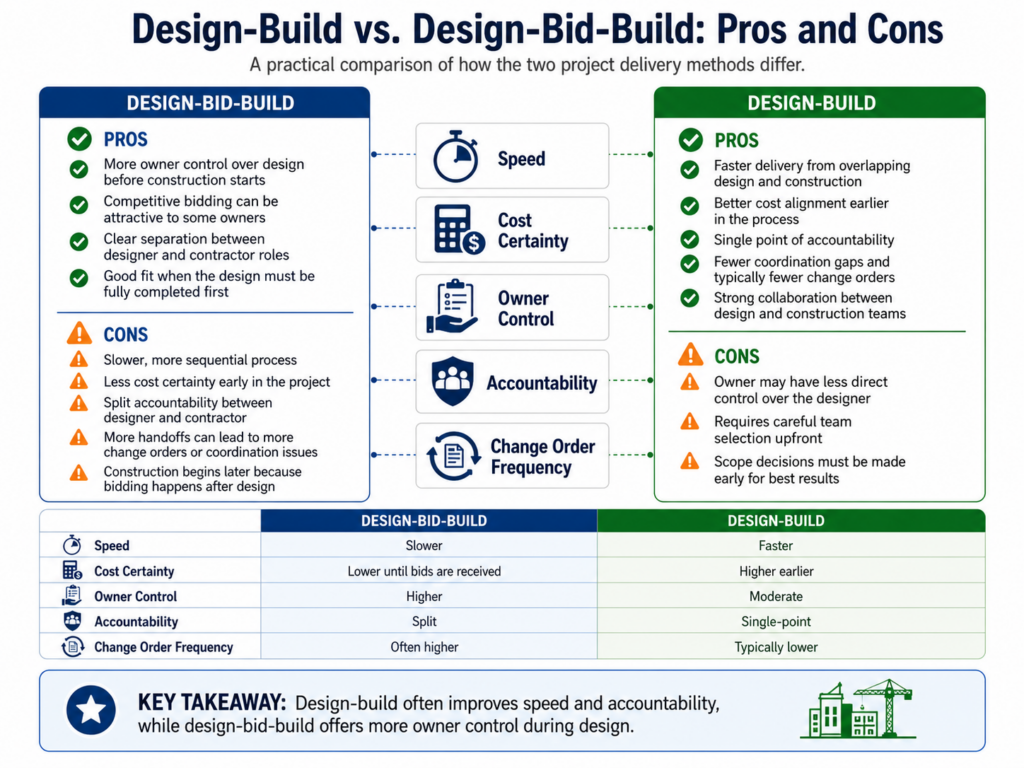
DBB stands for Design-Bid-Build, which is the traditional delivery model that dominated construction for most of the 20th century. The sequence is exactly what the name implies: the owner commissions a complete design, then solicits bids from contractors, then awards a separate construction contract.
The structural difference matters more than most owners realize. In DBB, if a contractor finds a conflict in the drawings, the dispute goes back to the architect, who may issue a clarification or a change order. That back-and-forth costs time and often money. In design-build, the same firm resolves it internally, usually in a meeting that the owner never has to attend.
| Factor | Design-Build | Design-Bid-Build |
| Number of contracts | One | Two or more |
| Project speed | Faster (phases overlap) | Slower (phases are sequential) |
| Owner design control | Moderate | High |
| Cost certainty | Earlier, often locked in pre-construction | Later, after full design is complete |
| Accountability | Single entity | Divided between architect and contractor |
| Best for | Well-defined scope, speed-critical projects | Projects needing maximum design iteration |
What’s the Difference Between Design-Build and Progressive Design-Build?
Progressive design-build (PDB) is a newer variation that addresses one of the main criticisms of traditional design-build: that owners are pushed to commit too early. In PDB, the owner selects the design-build team based on qualifications rather than a fixed price, then collaborates with that team through the early design phases before a final contract price is established.
Think of it as design-build with a runway. The team earns the owner’s trust during a defined pre-construction phase, and both parties validate scope and cost before locking in. This is particularly common in public infrastructure projects, where regulatory requirements demand more deliberate owner engagement before full commitment.
Progressive design-build has grown significantly in adoption across state transportation departments and municipal water authorities since 2018, largely because it allows public agencies to satisfy procurement transparency requirements while still capturing the collaboration benefits of integrated delivery.
How to Know If a Project Is Design-Build
The clearest signal is the contract structure. If the owner signs one agreement that covers both design services and construction services with a single firm, it’s design-build. If there are separate contracts, one with an architect and one with a general contractor, it’s not.
Other indicators include a guaranteed maximum price established before design is complete, a single project manager handling both design coordination and construction scheduling, and a team that includes licensed architects and engineers employed by or subcontracted directly through the contractor. When Buildform presents a proposal, for example, it outlines both the design scope and the construction scope in the same document, with one integrated fee structure. That’s a reliable hallmark of genuine design-build delivery.
Step-by-Step: How the Design-Build Process Typically Works
- Owner defines the program: Before any design work starts, the owner documents project goals, budget constraints, performance requirements, and timeline expectations. The more clearly this is defined, the better the DB team can deliver against it.
- Design-builder selection: Owners evaluate firms based on qualifications, relevant experience, and sometimes a preliminary design concept or bridging documents. This is often a qualifications-based selection rather than a pure low-bid process.
- Preliminary design and pricing: The selected team develops schematic designs and produces a detailed cost estimate, often establishing a guaranteed maximum price at this stage or shortly after.
- Design development and construction overlap: Unlike traditional delivery, construction can begin on completed portions of the project while other areas are still being designed. This phase overlap is where the schedule savings are realized.
- Construction and closeout: The team completes the build, manages all subcontractors, handles inspections, and delivers a fully finished project with a single punch list resolved under one contractual relationship.
Common Mistakes Owners Make in Design-Build Projects
- Starting with an undefined scope: Design-build accelerates decisions. Owners who haven’t clarified their program before kickoff end up approving design choices they later want to reverse, which triggers expensive changes.
- Skipping the owner’s representative: Without an independent advisor reviewing costs and design quality, owners lose visibility into whether the integrated team’s decisions are in the owner’s best interest or the team’s.
- Selecting on price alone: The lowest DB proposal often reflects a design that corners were cut on during pricing. Selecting on qualifications and past performance typically produces better outcomes than chasing the lowest number.
- Assuming “one contract” means no oversight needed: Single accountability doesn’t mean passive ownership. Regular milestone reviews and open-book cost access are still essential for keeping a project on track.
- Confusing design-build with fast-track construction: Design-build is a delivery method, not a promise of reckless speed. Responsible design-build teams still take time to produce quality drawings and validate constructability before breaking ground.
Frequently Asked Questions
Is design-build more expensive?
Not typically, and in many cases it costs less in total. While the unit costs for design services and construction may not be lower, the savings come from reduced change orders, faster delivery (which cuts carrying costs and financing expenses), and tighter budget management from the start. A project delivered two months earlier can save an owner more than the cost difference between delivery methods.
What’s the difference between EPC and design-build?
EPC, or Engineering, Procurement, and Construction, is a specific form of design-build used heavily in industrial, energy, and infrastructure sectors. The key difference is that EPC contracts explicitly include the procurement of all major materials and equipment under the same contract umbrella. Standard design-build agreements may leave procurement to the owner or handle it less formally. For a manufacturing plant or a power facility, EPC is the standard term. For a commercial office building or a residential development, design-build is the more common designation.
What are the 5 phases of the design-build process?
The five phases are: program definition (owner establishes goals and requirements), team selection (choosing the design-builder through qualifications or proposals), preliminary design and pricing (schematic design with an early cost commitment), design development with overlapping construction (phased execution where completed sections are built while others are still designed), and closeout and commissioning (final inspections, punch list resolution, and turnover). Not every project uses exactly five phases, but this framework reflects the most common industry structure.
What is the legal definition of design-build?
Legally, design-build is defined as a project delivery system where a single entity, the design-builder, holds a single contract with the owner and is responsible for both the design and the construction of the project. The Federal Acquisition Regulation (FAR) defines it similarly for government contracts, and many U.S. states have enacted specific design-build enabling statutes for public procurement. The legal significance is that the design-builder assumes liability for both design errors and construction defects, which is fundamentally different from the divided liability structure in design-bid-build.
What is a design-build?
A design-build is a construction project delivered under a single integrated contract that covers both architectural or engineering design and physical construction. Rather than two separate firms completing those roles under separate agreements with the owner, one team handles both. The owner interacts with a single point of contact, receives a unified budget, and benefits from a coordinated team working toward the same outcome without adversarial handoffs between design and construction phases.
Ready to Deliver Your Project the Smarter Way?
Design-build isn’t a shortcut. It’s a smarter structure, one that removes the built-in inefficiencies of traditional delivery and replaces them with coordinated accountability. When the team designing your project is the same team building it, the incentives align, the communication improves, and the results tend to speak for themselves.
If you’re evaluating whether design-build is the right fit for your next project, Buildform works with owners at every stage to clarify scope, establish realistic budgets, and deliver integrated projects with one clear point of contact throughout. Contact us directly to talk through your project goals with someone who can give you a straight answer on what delivery method actually makes sense for your situation.