The four methods of valuing variations in design-build contracts are: agreed lump sum pricing, bill of quantities rates, daywork rates, and fair valuation by the contract administrator. Each method applies in different circumstances depending on what information is available, how similar the variation is to original contract work, and whether agreement can be reached between the parties before work begins.
Variations in design-build projects are practically unavoidable. Scope changes, unforeseen site conditions, and client-driven amendments can shift the original contract value significantly, and without a clear valuation method in place, disputes follow quickly. The question most project managers, contractors, and clients face isn’t whether variations will happen — it’s how those variations will be priced fairly and consistently when they do.
Key Takeaways
- The four primary valuation methods are agreed lump sum, bill of quantities rates, daywork, and fair/reasonable valuation — applied in a hierarchy depending on the situation.
- Agreed lump sum is the preferred method because it removes ambiguity before work starts, but it requires both parties to reach consensus early.
- Daywork rates are a last resort, typically reserved for work that cannot be defined in advance or measured after the fact.
- Fair valuation is the fallback when no rates exist and the work is too complex for daywork — this method gives the contract administrator the most discretion.
- Variation valuation disputes are one of the leading causes of construction contract litigation, making the method selection critical from the outset.
- Design-build contracts, unlike traditional procurement, bundle design risk with construction risk, which affects how variations are scoped and valued differently from standard build-only contracts.
Why Variation Valuation in Design-Build Is Different From Traditional Contracting
In a traditional design-bid-build project, the design is complete before a contractor is engaged. Variations are measured against a defined set of drawings and a bill of quantities, making pricing relatively straightforward. Design-build contracts work differently. The contractor carries responsibility for both design development and construction, meaning that a variation instruction can trigger changes at both levels simultaneously.
Related Blog: 7 Steps in the Design Process
This dual exposure creates a more complex pricing environment. A client instruction to change a structural system mid-design, for example, doesn’t just affect material costs. It affects engineering fees, detailing time, procurement lead times, and potentially the sequencing of the entire build. Failing to account for these layers is where most variation claims go wrong.

Research across construction dispute resolution bodies indicates that variation and change order disputes account for a significant proportion of all contractor claims, with some industry analyses placing the figure at over 40% of total claim value on complex commercial projects.
Method 1: Agreed Lump Sum
This is the cleanest and most commercially preferred method. Before the varied work begins, the contractor submits a priced proposal and both parties agree on a fixed sum. Once signed off, that figure holds regardless of what the work actually costs to execute.
The practical advantage is certainty. The client knows exactly what the variation will add to the contract sum. The contractor carries the risk of underpricing but also retains the upside if they execute efficiently. For Buildform project teams managing complex design-build programmes, getting agreed lump sums locked in early is standard practice precisely because it eliminates the ambiguity that drags out final account negotiations.
The challenge arises when time pressure prevents proper agreement before work starts. If a contractor proceeds under a verbal instruction and tries to price the work retrospectively, the agreed lump sum method breaks down and the parties are forced into one of the other three methods instead.
Method 2: Bill of Quantities Rates (Measured Rates)
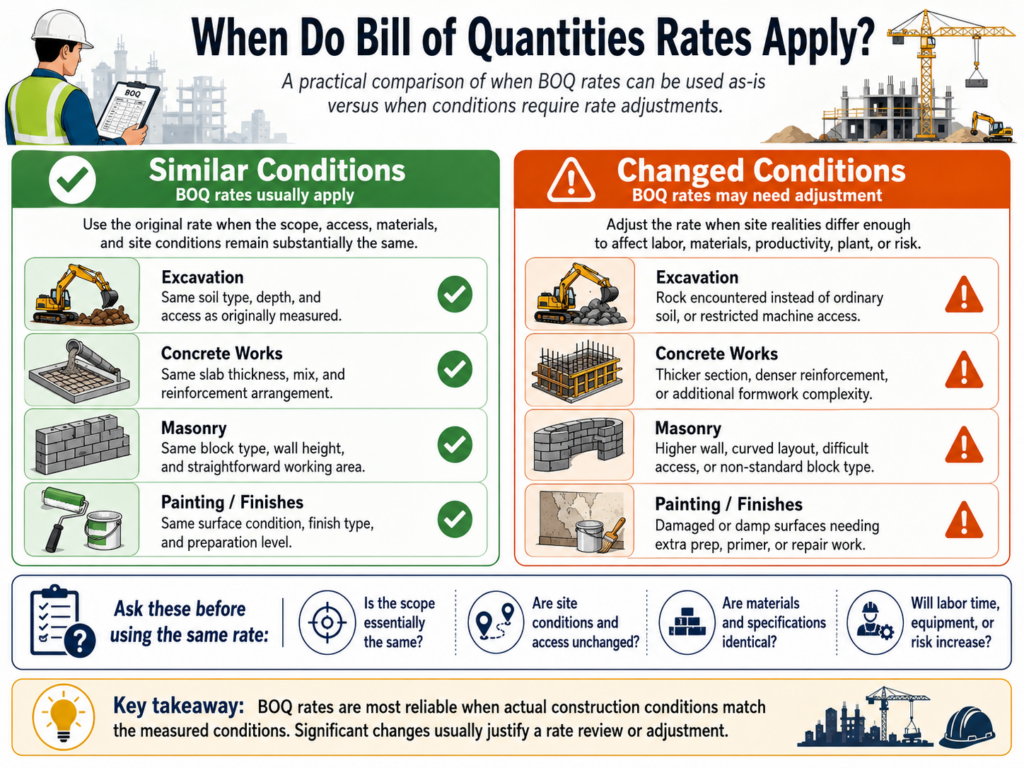
Where a contract includes a priced bill of quantities or schedule of rates, those rates are used to value similar varied work. The logic is straightforward: if the contractor priced excavation at a given rate during the tender, the same rate should apply to additional excavation instructed as a variation, assuming conditions are comparable.
Under standard forms such as NEC4 and JCT Design and Build 2016, bill of quantities rates apply to varied work only where the work is of a similar character to the original scope and is carried out under similar conditions — a qualification that frequently becomes the subject of dispute when site conditions or programme circumstances have changed materially.
The “similar character and conditions” test is where this method gets contested. A rate tendered for brickwork in an accessible ground floor location isn’t necessarily fair for the same brickwork 18 metres up on a facade that now requires additional scaffold. Contractors often argue that conditions have changed sufficiently to justify a rate adjustment. Clients often push back. The resolution usually comes down to how clearly the contract defines similarity thresholds.
Method 3: Daywork
Daywork is a cost-reimbursable method where the contractor records actual labour hours, plant usage, and materials consumed on the varied work, then prices them using agreed daywork schedules or standard published rates such as the RICS Daywork Schedule.
It exists as a fallback for situations where the variation cannot be practically measured or where the work is so disruptive to normal operations that a measured rate wouldn’t capture true cost. Think about a situation where an instruction requires the contractor to dismantle, relocate, and reinstall a completed mechanical plant because the client changed a room’s intended use. The labour involved in that sequence is difficult to quantify in advance and awkward to measure cleanly afterward. Daywork handles it.
Daywork typically includes uplifts on labour costs to account for contractor overheads and profit, with percentage additions commonly ranging from 100% to 175% on base labour rates depending on the contract and market conditions at the time of tender.
The significant risk with daywork is that it removes the contractor’s incentive to work efficiently. Because the client pays for actual hours, a slow crew costs more than a productive one. For this reason, most experienced clients and quantity surveyors treat daywork as a last resort rather than a default, and some contracts require prior written agreement before daywork records are accepted as valid.
Method 4: Fair and Reasonable Valuation
When none of the first three methods apply cleanly, the contract administrator or quantity surveyor must determine a fair and reasonable value for the variation. This is the most discretionary of the four methods and also the most likely to produce disagreement between parties.
Fair valuation draws on market rates, analogous contractor pricing from comparable projects, published cost data, and professional judgment. It’s essentially an independent assessment of what a competent contractor would have priced the work at had it appeared in the original tender. In practice, contractors typically submit a cost build-up and the QS scrutinises it against market benchmarks, negotiating downward where rates appear inflated.
Fair valuation disputes represent a disproportionate share of adjudication referrals in UK and US construction markets, partly because the method introduces subjectivity that the other three methods avoid. Industry bodies recommend that contracts define the valuation hierarchy explicitly to reduce reliance on fair valuation as a resolution mechanism.
How the Four Methods Work Together as a Valuation Hierarchy
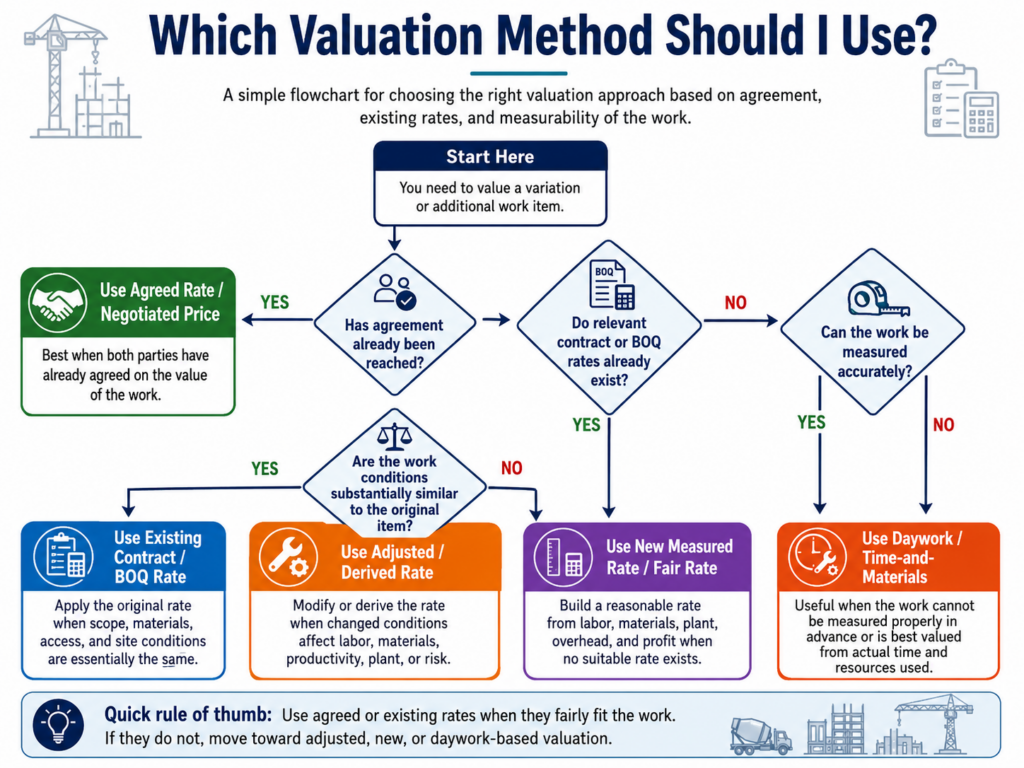
In well-drafted design-build contracts, these four methods operate as a hierarchy rather than alternatives. The contract specifies which method takes precedence and under what conditions you step down to the next. A typical hierarchy looks like this:
| Priority | Method | When It Applies | Who Carries Risk |
| 1 | Agreed Lump Sum | Both parties agree in advance | Contractor (fixed price) |
| 2 | Bill of Quantities Rates | Similar work exists in contract documents | Contractor (tendered rate) |
| 3 | Daywork | Work cannot be measured or valued by rate | Client (cost reimbursable) |
| 4 | Fair Valuation | No applicable rates, daywork not suitable | Disputed (QS discretion) |
Step-by-Step: How to Value a Variation in Practice
- Confirm the instruction is valid. Before pricing anything, verify the variation instruction has been issued in writing by an authorised party. Oral instructions without written confirmation create significant risk for contractors who proceed and then struggle to recover costs.
- Categorise the work. Determine whether the varied work is similar to original scope items, completely new work, or disruptive work that interrupts existing activities. This categorisation drives the method selection.
- Attempt agreed lump sum first. Submit a detailed priced proposal promptly. The longer this process takes, the more likely the client will need to issue a provisional instruction and the harder the agreement becomes retrospectively.
- Apply bill of quantities rates if agreement fails. Cross-reference the variation scope against the contract’s schedule of rates. Document where conditions differ from the original assumptions underlying those rates.
- Open daywork sheets if measurement is impractical. Ensure daywork sheets are signed by a supervising engineer or site manager on the day. Unsigned retrospective sheets are routinely challenged or rejected.
- Engage QS for fair valuation if all else fails. Provide a detailed cost build-up with supporting market evidence. The more transparent the submission, the faster the QS assessment and the lower the risk of a deep reduction.
Common Mistakes That Cause Variation Claims to Fail
- Proceeding without a written instruction: One of the most consistent errors in practice. Contractors begin varied work on verbal direction and later find the client disputes the instruction entirely.
- Submitting unsigned daywork sheets: Daywork records need contemporaneous sign-off. Sheets submitted weeks after the work is complete are a red flag during final account reviews.
- Applying tender rates without adjusting for changed conditions: Using the original rate for work performed in materially different circumstances can significantly undervalue a variation and set a precedent for the rest of the account.
- Failing to claim design variation costs: In design-build, variations often trigger additional design fees from engineers and architects. These costs are recoverable but only if they are tracked, documented, and submitted as part of the variation claim.
- Leaving valuation until the end of the project: Final account negotiations conducted under programme pressure almost always favour the paying party. Variations should be agreed progressively throughout the project lifecycle.
- Misidentifying the valuation method in the contract: Some design-build forms have nuanced hierarchies or exclusions. Misreading the contract can result in applying the wrong method, which weakens the claim’s contractual basis.
Variation Valuation Across Common Contract Forms
| Contract Form | Valuation Hierarchy | Key Provision |
| JCT Design and Build 2016 | Agreed / Rates / Fair valuation | Section 5 — Valuation of Variations |
| NEC4 ECC | Defined Cost + fee (compensation events) | Clauses 63–65 — Compensation Events |
| FIDIC Yellow Book | Agreed / Contract rates / Engineer determination | Clause 13 — Variations and Adjustments |
| AIA A141 | Change order pricing / Time and material | Article 6 — Changes in the Work |
Frequently Asked Questions
What are the four methods of valuing variations?
The four methods are agreed lump sum, bill of quantities rates, daywork, and fair and reasonable valuation. They are typically applied in that order of preference, with agreed lump sum being the most commercially certain and fair valuation representing the most subjective fallback. The applicable method in any given situation depends on the contract terms and the nature of the varied work.
What are the 4 types of bidding?
The four main types of bidding in construction are open competitive tendering, selective tendering, negotiated tendering, and two-stage tendering. Open tendering invites any qualified contractor to submit a price. Selective tendering restricts the process to a pre-qualified shortlist. Negotiated tendering involves direct pricing discussions with a single contractor. Two-stage tendering separates design development from construction pricing, which is common in design-build procurement.
What are the 4 types of construction contracts?
The four primary construction contract types are lump sum (fixed price), cost plus (reimbursable), time and materials, and unit price contracts. Lump sum contracts transfer the majority of cost risk to the contractor. Cost plus contracts reimburse the contractor’s actual expenditure plus a fee. Time and materials contracts pay for labour and materials as consumed. Unit price contracts are based on pre-agreed rates applied to measured quantities of work completed.
How are variations valued?
Variations are valued by applying the method specified in the contract’s variation clause, typically following a defined hierarchy. The valuation process starts with an attempt to agree a lump sum before work begins. If agreement isn’t reached, the quantity surveyor applies existing contract rates, daywork schedules, or fair valuation principles depending on what information is available and what the contract permits. Documentation of actual costs, signed records, and a transparent cost build-up all strengthen a variation claim regardless of the method used.
What are the four methods of valuation?
In the broader context of surveying and property, the four recognised methods of valuation are the comparison method, the investment method, the residual method, and the profits method. In a construction contract context, the equivalent four methods refer specifically to agreed lump sum, measured rates, daywork, and fair valuation as described in this article. The correct interpretation depends on whether the question relates to real property valuation or construction variation pricing.
Final Thoughts on Getting Variation Valuation Right
Variation valuation isn’t purely a contractual exercise. It’s a commercial one. The method you end up applying often depends more on how well the variation was managed before work started than on what the contract says. Contractors who move quickly to lock in agreed lump sums, keep clean daywork records, and submit variation notices promptly consistently recover more than those who rely on retrospective claims and fair valuation arguments.
Design-build projects carry additional complexity because the scope at any point in the project is partly defined, partly in development. That moving target makes clear variation management protocols even more valuable, not less.
If you’re working through variation pricing on a current project or reviewing your design-build contract structure, the team at Buildform can help you build a valuation framework that protects your position throughout the project lifecycle. Reach out directly Buildform to speak with a specialist.